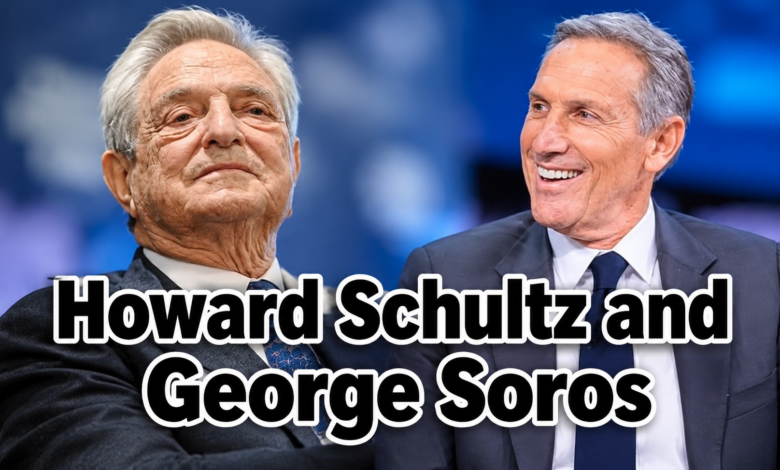
Howard Schultz and George Soros: Powerful Stories of Business, Wealth, Politics, and Influence

Introduction
Howard Schultz and George Soros are two internationally recognized billionaires whose careers have shaped different areas of business, finance, and public life. Schultz became famous for transforming Starbucks into one of the world’s leading coffee brands, while Soros established himself as a successful investor and philanthropist through his financial activities and the Open Society Foundations.
Although Howard Schultz and George Soros followed different professional paths, their names have appeared together in political discussions. Their documented connection involves American Bridge 21st Century, a Democratic research organization that received donations from Soros and later filed a Federal Election Commission complaint concerning Schultz’s potential independent presidential campaign in 2019.
There is no publicly established evidence that the two men were business partners or maintained a direct personal relationship. Understanding Howard Schultz and George Soros requires examining their individual achievements, political activities, and the available public records.
Quick Bio: Howard Schultz and George Soros
| Details | Howard Schultz | George Soros |
|---|---|---|
| Full Name | Howard D. Schultz | George Soros |
| Birth Date | July 19, 1953 | August 12, 1930 |
| Birthplace | Brooklyn, New York | Budapest, Hungary |
| Nationality | American | Hungarian-American |
| Education | Northern Michigan University | London School of Economics |
| Profession | Businessman | Investor and philanthropist |
| Known For | Building Starbucks | Quantum Fund |
| Foundation | Schultz Family Foundation | Open Society Foundations |
| Reported Net Worth | Approximately $4.3 billion (October 2020) | Approximately $6.7 billion (October 2023) |
Who Is Howard Schultz?
Howard Schultz is an American businessman best known for developing Starbucks into a worldwide coffee company. His leadership helped transform the brand from a small Seattle coffee retailer into an internationally recognized business.
Born on July 19, 1953, in Brooklyn, New York, Schultz experienced financial difficulties during his childhood. He grew up in the Canarsie public housing projects. His father, Fred Schultz, worked as a truck driver.
One important childhood experience influenced his future leadership philosophy. When Schultz was seven, his father suffered an ankle injury. Because the family lacked health insurance, they experienced financial difficulties. Schultz later referred to this experience when discussing the importance of employee benefits.
He attended Northern Michigan University before beginning his professional career in sales. One of his early positions was at Hammarplast, where he worked with European coffee-making products.
How Howard Schultz Built Starbucks
Schultz joined Starbucks in 1982 as director of retail operations and marketing. At that time, Starbucks primarily sold whole coffee beans rather than operating the large coffeehouse network people recognize today.
In 1985, he left the company to establish his own coffee business. Finding investors was challenging. Out of 242 investors he approached, 217 rejected his proposal.
Eventually, Schultz brought the Starbucks name under his control and began expanding the business.
His leadership included several important milestones:
- 1982: Joined Starbucks as director of retail operations and marketing.
- 1985: Left Starbucks to establish his own coffee business.
- 2008: Returned as CEO during a difficult financial period.
- 2017: Kevin Johnson became CEO.
- 2018: Stepped down as chairman.
- 2022–2023: Returned as interim CEO before leaving in March 2023.
Schultz’s return in 2008 involved difficult decisions, including closing hundreds of stores and reducing jobs. Supporters viewed these actions as necessary to strengthen Starbucks, while critics focused on their impact on employees.
Howard Schultz’s Leadership and Employee Benefits
Another important part of Schultz’s business legacy involves employee welfare. Starbucks refers to its employees as partners and developed several benefits during his leadership.
These included healthcare coverage for eligible part-time employees, Bean Stock equity grants introduced in 1991, and the College Achievement Plan launched in 2014 in partnership with Arizona State University.
The education program provides eligible employees with tuition coverage for online degrees.
However, Starbucks has also faced criticism over workplace conditions, scheduling, compensation, and union organizing. Schultz defended the company’s benefits record during his 2023 testimony before the U.S. Senate HELP Committee.
Who Is George Soros?
George Soros is a Hungarian-American investor and philanthropist recognized for his achievements in international finance and charitable giving.
He was born György Schwartz on August 12, 1930, in Budapest, Hungary. His family changed its surname to Soros in 1936 as protection during an increasingly hostile political environment.
During World War II, Nazi Germany occupied Hungary in March 1944. Soros was 13 years old at the time. His family survived by using false identities and hiding.
At 17, he moved to England and studied philosophy at the London School of Economics. He earned his bachelor’s degree in 1951 and master’s degree in 1954. The philosopher Karl Popper influenced his thinking about open societies and political institutions.
George Soros’s Financial Career and Investment Success
Soros began working in finance as an arbitrage trader and analyst before moving to New York.
In 1970, he established Soros Fund Management alongside investor Jim Rogers. Their investment operation eventually became associated with the famous Quantum Fund.
One of his most recognized financial achievements occurred during the 1992 Black Wednesday currency crisis. Soros made a major investment against the British pound, reportedly earning approximately $1 billion.
This achievement contributed to his reputation as one of the world’s most successful investors. Newspapers famously described him as the man who broke the Bank of England.
Soros also developed his ideas about financial markets through his book The Alchemy of Finance, which discusses his theory of reflexivity.
Philanthropy and the Open Society Foundations
George Soros expanded his influence beyond investment through philanthropy. In 1993, he founded the Open Society Foundations, an organization supporting education, human rights, public health, and independent media.
By October 2023, reference sources reported that he had donated more than $32 billion to the foundations.
He also supported Central European University in Budapest through significant educational funding. His son, Alex Soros, became chairman of the Open Society Foundations in 2023.
Soros has also participated in American political funding. During the 2004 presidential election, he reportedly spent $20 million or more opposing President George W. Bush.
Howard Schultz and George Soros: Comparing Their Careers
Howard Schultz and George Soros achieved financial success through different professional strategies.
Schultz focused on business operations, consumer experiences, employee management, and international brand development. His Starbucks leadership involved managing stores, supply chains, marketing, and workplace culture.
Soros concentrated on financial markets, investment strategies, and managing financial risks. His success depended on analyzing economic developments and identifying investment opportunities.
Their approaches to social impact also differ. Schultz established the Schultz Family Foundation, which supports veterans and young people seeking employment. Soros developed a global philanthropic network through the Open Society Foundations.
Although Howard Schultz and George Soros share billionaire status and public influence, their professional achievements reflect different industries and priorities.
What Connects Howard Schultz and George Soros?
The documented connection between Howard Schultz and George Soros involves American Bridge 21st Century.
Soros donated to this Democratic-aligned research organization. According to Ballotpedia, citing Federal Election Commission records, he contributed at least $4 million between 2012 and March 2016.
In January 2019, Schultz announced that he was exploring an independent presidential campaign. He described himself as a centrist and a lifelong Democrat.
His announcement attracted criticism from Democratic activists who feared an independent campaign could divide Democratic voters and benefit Donald Trump.
In February 2019, American Bridge 21st Century and its leader, Bradley Beychok, filed a complaint with the Federal Election Commission. The complaint alleged that Schultz had become a federal candidate through his public activities without completing the required registration and reporting obligations.
Schultz ended his presidential exploration on September 6, 2019. He cited health concerns, including a back injury that required three surgeries, as well as the difficulties surrounding an independent campaign.
The FEC matter was identified as MUR 7567. In November 2021, the agency dismissed the allegation and closed the case.
Importantly, available records do not establish that Soros personally directed the complaint or had direct involvement in the decision.
Differences Between Their Political Influence
Howard Schultz and George Soros have participated in American public life through different channels.
Schultz explored an independent presidential campaign and described himself as a lifelong Democrat. His public influence primarily developed through Starbucks, business leadership, and his charitable foundation.
Soros has supported Democratic-aligned political organizations through financial contributions. His philanthropic activities also reach educational institutions, advocacy organizations, and media groups.
Their approaches have attracted both supporters and critics. Schultz has faced questions about Starbucks’ workplace practices, while Soros has faced debates about the influence of billionaire political donations.
Frequently Asked Questions
1. Who is Howard Schultz?
Howard Schultz is an American businessman and former Starbucks CEO known for transforming the coffee company into a global brand.
2. Who is George Soros?
George Soros is a Hungarian-American investor and philanthropist who founded Soros Fund Management and the Open Society Foundations.
3. Are Howard Schultz and George Soros business partners?
No publicly available evidence establishes a business partnership or direct business relationship between them.
4. What connects Howard Schultz and George Soros?
Their documented indirect connection involves American Bridge 21st Century, an organization that received donations from Soros and filed an FEC complaint concerning Schultz in 2019.
5. Did Howard Schultz run for president?
No. He explored an independent presidential campaign in 2019 but officially ended the possibility on September 6, 2019.
6. Did George Soros personally file a complaint against Howard Schultz?
There is no established evidence that Soros personally directed or filed the complaint. American Bridge 21st Century submitted it.
7. Did the FEC punish Howard Schultz?
No. The Federal Election Commission dismissed the allegation and closed the matter in November 2021 without penalizing Schultz.
8. How much money has George Soros donated?
As of October 2023, reference sources reported that Soros had donated more than $32 billion to the Open Society Foundations.
Conclusion
Howard Schultz and George Soros represent two different approaches to wealth creation, leadership, and public influence. Schultz built an internationally recognized coffee business through entrepreneurship and corporate management, while Soros achieved financial success through investment and later became widely recognized for his philanthropic activities.
The connection between Howard Schultz and George Soros is indirect and primarily political. Soros supported American Bridge 21st Century, which subsequently filed an FEC complaint concerning Schultz’s potential presidential campaign in 2019. The agency later dismissed the allegation and closed the matter.
Ultimately, their stories demonstrate how successful individuals can influence business, society, and politics in different ways. Understanding the documented facts helps separate their genuine connection from unsupported claims.